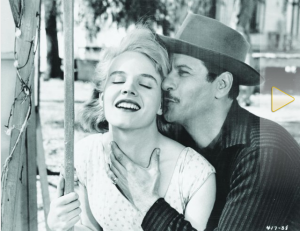
 Baby Doll directed by Elia Kazan. 1956
I’m making my way through the Elia Kazan box set. Can I say, or rather - ask - something heretical? Tennessee Williams, is he really all that great? I knew about only a couple of Tennessee Williams plays before I moved to Hollywood, most important was Summer and Smoke. If I had to say, I would still name Summer and Smoke as my favorite, and in my opinion, the best Williams play. I seem to be in a minority on this one. Later I saw or read William’s other plays. I used to have a knee-jerk, politically correct, learned admiration for Tennessee Williams. But, do I really feel that way?
In any case, after watching Streetcar Named Desire, also directed by Kazan, and now Baby Doll, I’m leaning towards an opinion that surprises me. I think Tennessee Williams is way, way, WAY too broad. And worse: blindingly simple. When I was a performer at The Groundlings, an improv company, we would often get a suggestion of Tennessee Williams when we performed games involving playwrights. We did Williams by having exaggeratedly comic southern accents, throwing around the words “mint julep” and imbuing everything with a comic sultry sexuality and hints of incest and alcohol fueled monologues.
Now I’m wondering if our comic portrayals were really exaggerated! Both Streetcar Named Desire and Baby Doll seem absurd to me, now. Who would ever behave like this? I find it hard to believe. It’s like watching someone in blackface mimicking exaggerated (and flat-out fanciful) black behavior for laughs.
I don’t think the portrayal of demented and twisted people is offensive, in fact some of my favorite films are about twisted, demented people (Taxi Driver comes to mind.) But Williams characters and plot lines don’t ring as authentic to me. While I’m sure situations like the ones in Baby Doll occurred in the south, or even other places, I don’t think they were played out with such operatic, scream-y, playing it to the back-of-the-house broadness.
If I watch Baby Doll in a certain way, I do find it appealing. Like one of the comically broad Coen Bros. movies, such as Raising Arizona, I can almost see how people’d like it. I didn’t like Raising Arizona at first. I liked it later, the second time around. Maybe I’d feel that way about Baby Doll too if I gave it another chance. But I don’t want to. I was excited to be done with those people as soon as it ended.
To me, it’s not entertaining, it’s just irritating. I can only - sort of - appreciate it intellectually, not viscerally. It’s too in-your-face, too unbelievably captured, too farcical to have real emotional impact.
The Catholic Legion of Decency condemned this film. I might have too, but for totally different reasons than the Catholic Church. I would have declared the acting so over-the-top that it might be harmful to those who were not forewarned. Karl Malden’s character is absurd, and so is Carroll Baker’s. Eli Wallach is great fun to watch, he always is. This was his film debut. But his good comically and complex (yet also broad) performance is drowned out by the screeching of the others.
So far, I think Kazan’s A Tree Grows In Brooklyn is his best! I like so much about that movie. I like it better than On The Waterfront even. That small apartment in Brooklyn seems real, the situations seem understandable, and there’s a lot of subtlety. This is ironic, because Kazan thought A Tree wasn’t that good. He felt hampered by having to film on a stage. I disagree with his own assessment of his work. I guess I would say, so far, my list of Kazan fav’s are: 1.) A Tree Grows in Brooklyn 2.) On The Waterfront 3.) A Face in the Crowd 4. Gentleman’s Agreement.
A Face in the Crowd is a good example of an over-the-top character that actually works well. Andy Griffith’s Lonesome Rhodes is obnoxious and broad and manic, but he’s believable to me.
April 08, 2013 at 7:05 am, phd dissertation proposal format said:
Nice post i love that movie very much thanks for sharing
April 24, 2013 at 3:39 pm, Lisa Newsom said:
Funny, when I watched street car as a teenager I thought the characters were silly, I watched again as an adult, the film and several local “plays”. At that time I thought…”I must be missing something”.Glad to know I’m not the only one. I was glad to be done with Stella and the lot.
April 27, 2013 at 4:17 pm, Mary said:
I think Tennessee Williams writes sexist crap. Stella would have been an entirely different character if written by a woman- less pathetic.
June 01, 2013 at 6:10 am, felicity everett said:
Totally agree. Studied Williams at University, where there was an unspoken politically-correct reverence for his work, which I fell for. Still like Streetcar, but otherwise inclined to agree with you Julia. How about Suddenly Last Summer? Not just broad, not just screamy, mad as a box of frogs! Saw a production in London that had us leaving in tears (of laughter).
August 17, 2013 at 5:29 am, Silver Price said:
When the PCA took issue with this scene, Kazan argued that it was “physically impossible for any sexual activity to take place in such a limited area” (Walsh 274), yet the subsequent depiction of the couple, especially Baby Doll, overtly suggests that a considerable change has taken place. In early notes on the film, Kazan articulated his initial idea of Baby Doll’s character arc. He imagined Baby Doll as a woman “almost defeated . . . [having] lost her appetite for life and fun and sex” (qtd. in Schickel 331) who ultimately discovers ecstasy and happiness with Vacarro. Kazan wrote in his notes: “A bad initial motive brings on a miracle of living. Suddenly two starved people meet . . . and their last bit of sex play is sheer, wild, released exuberance, completely free and healthy . . . In fact, the most revolutionary, satisfying thing that has ever happened to them” (qtd. in Schickel 331). Although much of this was absent in the final version of the film, it indicates how Kazan linked sexual satisfaction and personal freedom. After their “nap,” Vacarro finds Baby Doll “different, grown up suddenly,” and Baby Doll declares feeling “cool and rested for the first time in my life” (Baby Doll 1956); the “mature viewer can hardly fail to notice the change or to connect it with a sexual awakening” (Brook 354). Even her costuming suggests the transformation—from “baby doll” pajamas and girlish dresses in the beginning to a slip during her seduction and finally to a darker skirt and sweater at the conclusion. Not surprisingly, the PCA “feared that reference to Baby Doll’s ‘growing up’ at the end of the story might be taken as an indication of her newfound sexual fulfillment” (Brook 354).
August 31, 2013 at 7:22 pm, Anita Z. Mosley said:
When the PCA took issue with this scene, Kazan argued that it was “physically impossible for any sexual activity to take place in such a limited area” (Walsh 274), yet the subsequent depiction of the couple, especially Baby Doll, overtly suggests that a considerable change has taken place. In early notes on the film, Kazan articulated his initial idea of Baby Doll’s character arc. He imagined Baby Doll as a woman “almost defeated . . . [having] lost her appetite for life and fun and sex” (qtd. in Schickel 331) who ultimately discovers ecstasy and happiness with Vacarro. Kazan wrote in his notes: “A bad initial motive brings on a miracle of living. Suddenly two starved people meet . . . and their last bit of sex play is sheer, wild, released exuberance, completely free and healthy . . . In fact, the most revolutionary, satisfying thing that has ever happened to them” (qtd. in Schickel 331). Although much of this was absent in the final version of the film, it indicates how Kazan linked sexual satisfaction and personal freedom. After their “nap,” Vacarro finds Baby Doll “different, grown up suddenly,” and Baby Doll declares feeling “cool and rested for the first time in my life” (Baby Doll 1956); the “mature viewer can hardly fail to notice the change or to connect it with a sexual awakening” (Brook 354). Even her costuming suggests the transformation—from “baby doll” pajamas and girlish dresses in the beginning to a slip during her seduction and finally to a darker skirt and sweater at the conclusion. Not surprisingly, the PCA “feared that reference to Baby Doll’s ‘growing up’ at the end of the story might be taken as an indication of her newfound sexual fulfillment” (Brook 354).
January 31, 2014 at 8:11 am, Bernadette Dyer said:
We did not know very much about the look and actions of the mentally ill back then when Street Car came out!
February 07, 2014 at 10:02 am, admin said:
I agree with you. I know we should be viewing art based on the cultural assumptions at the time the art was made, but still… Watching Street Car now, it’s so clear that Blanche Du Bois is mentally ill. With that in mind, it’s hard to have the kind of response that, I think, Tennessee Williams, is going for.